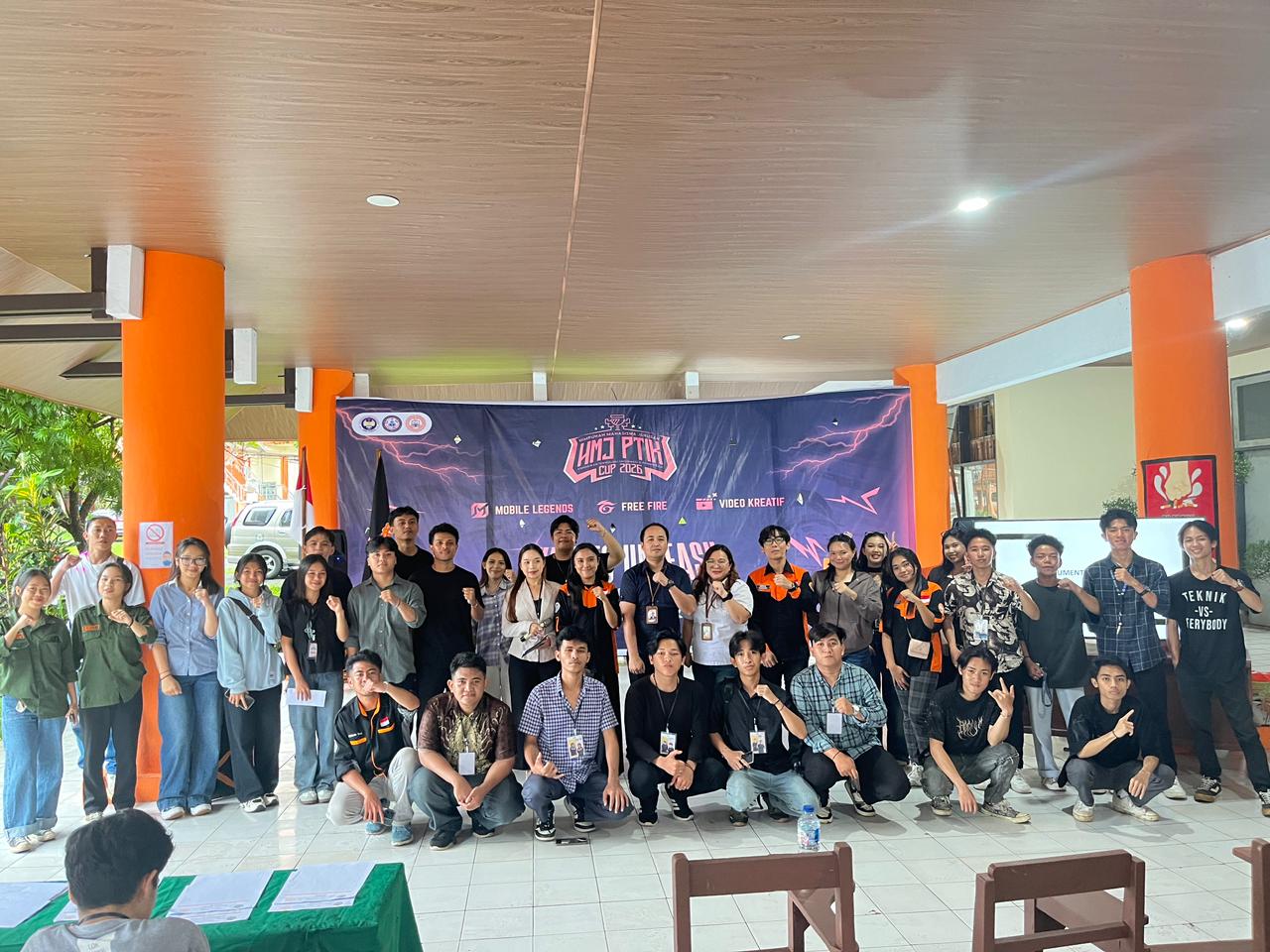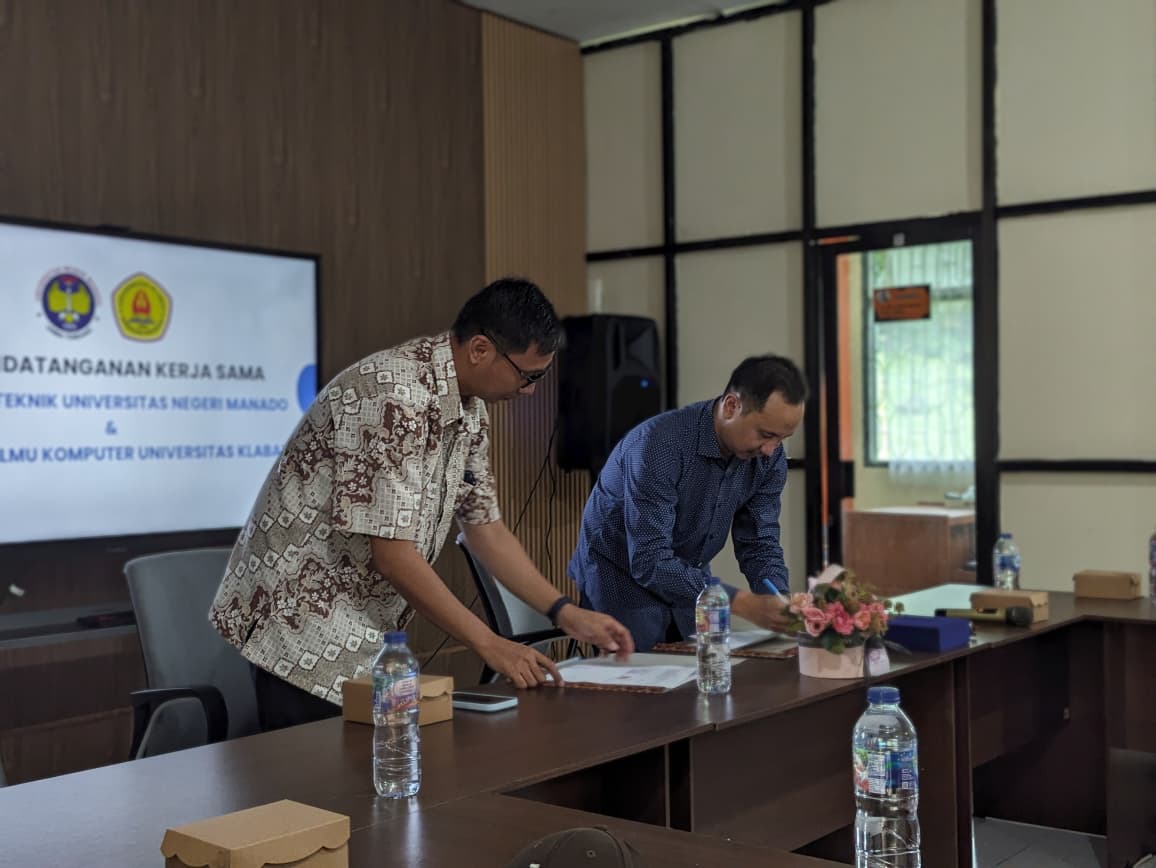
Tondano, April 14, 2026 — The Information and Communication Technology Education Study Program, Faculty of Engineering, Universitas Negeri Manado (UNIMA) officially entered into an implementation agreement with the Faculty of Computer Science, Universitas Klabat in support of the implementation of the Tri Dharma of Higher Education. The signing ceremony took place in Tondano on Tuesday, April 14, 2026, marking a shared commitment by both institutions to strengthen synergy and collaboration in higher education.
In the implementation document, the first party was represented by Dr. Arje C. Djamen, S.T., M.T., in his capacity as Head of the Department of Information and Communication Technology Education, Faculty of Engineering, Universitas Negeri Manado, while the second party was represented by Stenly R. Pungus, S.Kom, MT, MM, PhD, as Dean of the Faculty of Computer Science, Universitas Klabat. Both parties agreed to establish a constructive and sustainable partnership aimed at enhancing the quality of education, research, and community service.
This partnership represents a strategic step in strengthening institutional relations between two higher education institutions in North Sulawesi. In addition to serving as a follow-up to the memorandum of understanding and/or memorandum of agreement previously established, this implementation document also serves as a guideline for carrying out a range of collaborative programs.
In a spirit of collaboration and shared vision, both institutions emphasized that this agreement is not merely an administrative formality, but a concrete manifestation of their joint effort to foster higher education that is adaptive, innovative, and impactful for society.
Dr. Arje C. Djamen, S.T., M.T. expressed his optimism regarding the partnership, stating, “We view this implementation agreement as an important momentum to strengthen academic networks, improve the quality of the Tri Dharma implementation, and create collaborative programs that bring real benefits to students, lecturers, and the wider community.”
Meanwhile, Stenly R. Pungus, S.Kom, MT, MM, PhD underscored the importance of inter-university collaboration in addressing the challenges of education in the digital era. “A collaboration like this is an essential part of building an excellent academic ecosystem. We believe that through close cooperation, both institutions can support one another in the development of knowledge, innovation, and human resource capacity,” he remarked.
According to the agreement, the scope of cooperation covers a number of strategic areas, including education, research, and community service, as well as academic activities such as seminars, conferences, and workshops, both at the national and international levels. In addition, the partnership includes the provision of lecturers and professional experts, curriculum benchmarking, the assignment of senior lecturers as mentors, faculty and student exchanges, the exchange of peer reviewers for scientific journals, and internship programs.
The broad scope of this cooperation reflects the seriousness of both parties in building a partnership that is not merely ceremonial, but truly implementation-oriented and result-driven. These collaborative programs are expected to enrich the academic experience of the university communities while also expanding the contribution of higher education institutions to societal development.
The implementation of Tri Dharma-related activities will be carried out as needed, based on proposals submitted by either party. The form of activities and their venues will be adjusted to the scheme and characteristics of each program. This flexibility is one of the strengths of the agreement, as it allows both institutions to align their cooperation with academic needs and the evolving demands of the times.
This cooperation agreement is valid for three (3) years from the date of signing and may be extended based on mutual consent between both parties. This provision reflects a long-term vision in establishing a sustainable, focused, and mutually reinforcing institutional partnership.
With the implementation of this agreement, the Information and Communication Technology Education Study Program of the Faculty of Engineering, UNIMA and the Faculty of Computer Science, Universitas Klabat are expected to generate various positive breakthroughs in the development of higher education. This collaboration also stands as evidence that the spirit of togetherness, synergy, and commitment to academic excellence forms an essential foundation for realizing the Tri Dharma of Higher Education in a way that is increasingly relevant, progressive, and impactful.
Through this partnership, both institutions reaffirm their commitment to moving forward together, expanding academic networks, and delivering meaningful contributions to education and society. This synergy is expected to inspire other strategic collaborations in support of strengthening the quality of higher education in Indonesia.