In the constantly evolving digital era, multimedia does not only serve to present information but must also be able to provide engaging and meaningful experiences for users. Therefore, a design approach is required that is oriented not only towards the end result but also towards the process and user needs.
One approach that is widely used today is Design Thinking. This method helps designers, developers, and content creators to produce innovative solutions through a deep understanding of the user.
What Is Design Thinking?
Design Thinking is a human-centered problem-solving method. This approach combines empathy, creativity, and rationality to understand user needs and create effective solutions.
In the field of multimedia, Design Thinking is used to:
- Design interfaces (UI/UX)
- Develop interactive applications
- Create engaging digital content
- Enhance user experience
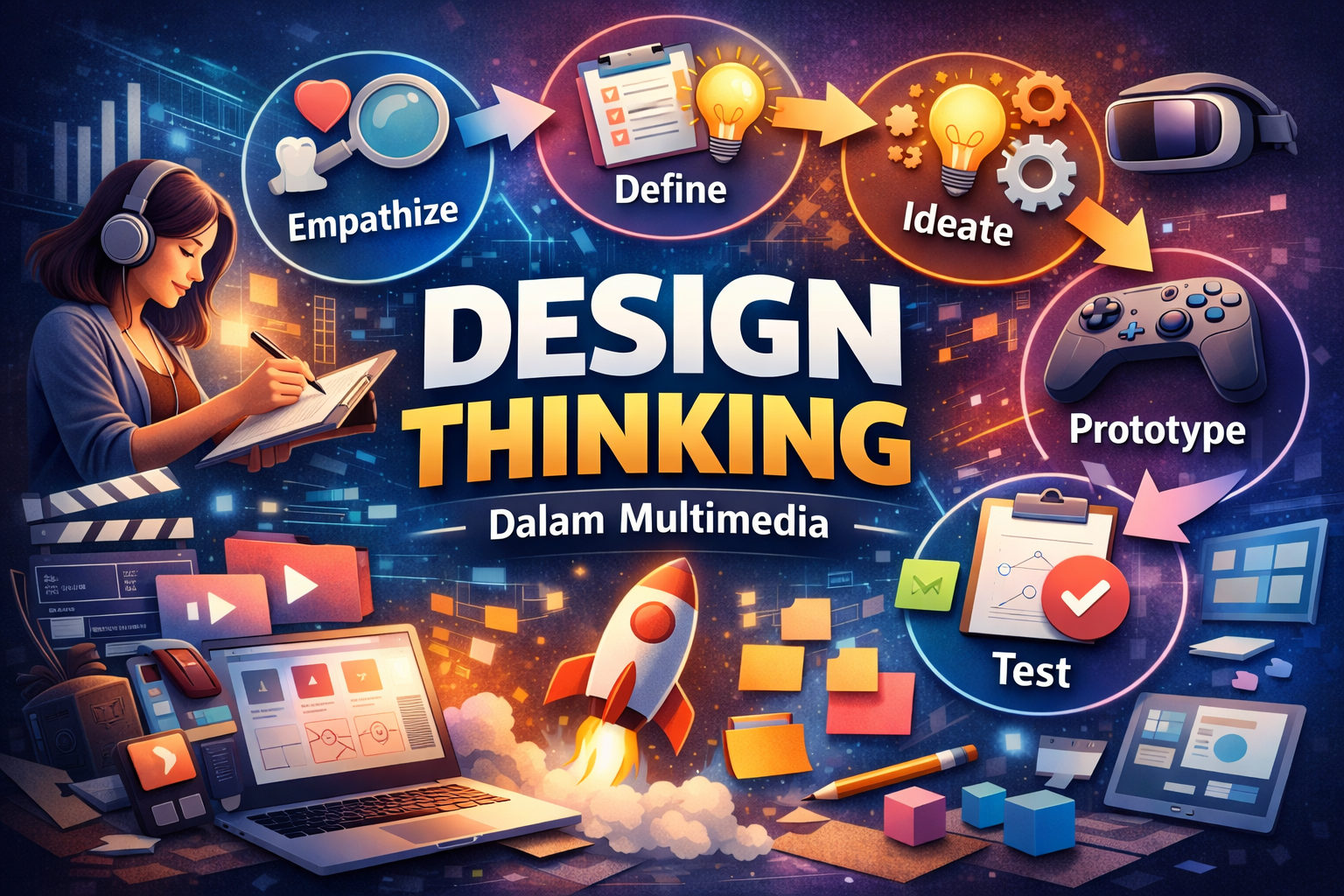
Stages of Design Thinking
Design Thinking consists of five main stages that are iterative (can be repeated):
1. Empathize
This stage aims to understand users deeply.
Activities performed:
- User observation
- Interviews
- Surveys
In multimedia: For example, understanding how users interact with an application or website.
2. Define (Problem Definition)
After understanding the user, the next step is to formulate the core problem.
Example: Users have difficulty understanding the navigation on a multimedia application.
Output: A clear and focused problem statement.
3. Ideate
At this stage, the team generates various creative ideas as solutions.
Techniques used:
- Brainstorming
- Mind mapping
- Sketching
Goal: To produce as many ideas as possible without limitations.
4. Prototype
The ideas created are then realized in a tangible form (early version).
Examples in multimedia:
- Wireframes
- UI Mockups
- Simple interactive videos
Benefit: Makes it easier to visualize solutions before further development.
5. Test
The final stage is testing the prototype with users.
Goal:
- Identify design flaws
- Get direct feedback
Result: Product refinement and perfection.
Application of Design Thinking in Multimedia
1. Mobile App Development
Design Thinking helps create user-friendly applications by understanding user needs from the beginning.
2. UI/UX Design
This approach ensures the visual appearance is not only attractive but also easy to use.
3. Digital Content Production
Content such as videos, animations, and infographics are created based on audience preferences and behavior.
4. Game Development
In game development, Design Thinking is used to create immersive and fun gaming experiences.
Advantages of Design Thinking
- User-oriented
- Encourages innovation
- Flexible and iterative
- Reduces the risk of product failure
- Increases user satisfaction
Challenges in Implementation
- Requires a significant amount of time
- Requires good team collaboration
- Not all organizations are ready for an innovative culture
- The iteration process can incur additional costs
Design Thinking is a highly relevant approach in modern multimedia development. By focusing on the user and an iterative process, this method is capable of producing products that are not only visually appealing but also functional and aligned with user needs.
In the competitive world of multimedia, the application of Design Thinking is key to creating innovative, effective, and sustainable solutions.