
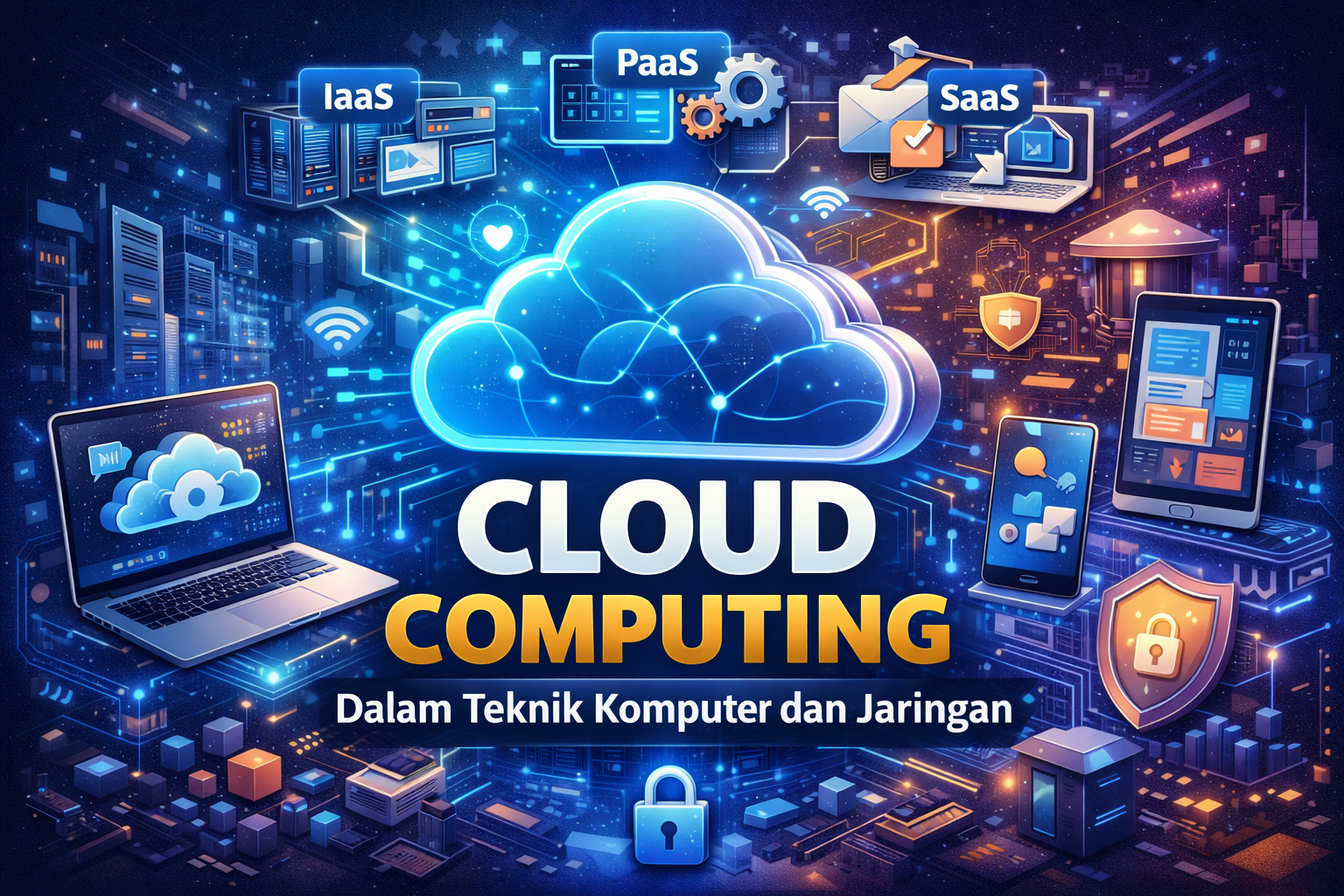
The development of information technology has changed the way organizations and individuals manage data and applications. While previously all data was stored locally (on-premise), many are now shifting to cloud-based systems.
In the context of Computer and Network Engineering (TKJ), cloud computing plays a vital role in:
- Server management
- Network infrastructure
- Data storage
- System security
The cloud not only provides ease of access but also increases operational efficiency and system flexibility.
What Is Cloud Computing?
Cloud Computing is a service model that provides computing resources such as servers, storage, databases, networks, and software over the internet (the cloud).
With cloud computing, users can:
- Access data from anywhere
- Use applications without local installation
- Save on infrastructure costs
Key Characteristics of Cloud Computing
According to industry standards, cloud computing has several key characteristics:
1. On-Demand Self-Service
Users can access services at any time without direct interaction with the service provider.
2. Broad Network Access
Services are accessible through various devices such as laptops, smartphones, and tablets.
3. Resource Pooling
Resources are pooled and shared by many users (multi-tenant).
4. Rapid Elasticity
Capacity can be quickly added or reduced according to needs.
5. Measured Service
Service usage is measured and paid for based on consumption (pay-as-you-go).
Cloud Computing Service Models
1. Infrastructure as a Service (IaaS)
Provides basic infrastructure such as virtual servers and networks.
Examples:
- Virtual Machines
- Cloud Storage
Advantage: Full control over the system.
2. Platform as a Service (PaaS)
Provides a platform for application development without having to manage the infrastructure.
Examples:
- Web application hosting
- Development frameworks
3. Software as a Service (SaaS)
Users directly use applications over the internet.
Examples:
- Web-based email
- Online office applications
Cloud Deployment Models
1. Public Cloud
Services are available to the general public over the internet.
2. Private Cloud
Used exclusively by a single organization.
3. Hybrid Cloud
A combination of public and private clouds.
4. Community Cloud
Shared by several organizations with similar requirements.
Implementation of Cloud Computing in TKJ
1. Server Virtualization
Using the cloud to create virtual servers without physical hardware.
2. Data Backup and Recovery
Data can be stored securely and recovered at any time.
3. Website and Application Hosting
Websites can be accessed globally with high performance.
4. Network Management
Network administration becomes easier and more centralized.
5. Internet of Things (IoT)
The cloud is used to manage data from IoT devices.
Advantages of Cloud Computing
- Cost-effective (no need to buy expensive hardware)
- High scalability
- Flexible access
- Good data security (with proper configuration)
- Automatic system updates
Challenges and Risks
- Dependence on internet connection
- Security and data privacy issues
- Downtime from service providers
- Vendor lock-in (dependence on one provider)
Security in Cloud Computing
Security is a crucial aspect of cloud computing. Several strategies used include:
- Data encryption
- Firewalls and IDS/IPS
- Multi-factor authentication (MFA)
- User activity monitoring
Cloud Computing has become a key technology in the world of Computer and Network Engineering. With its ability to provide flexible, efficient, and scalable services, the cloud enables organizations to grow faster in the digital era.
For TKJ students and practitioners, understanding cloud computing concepts is no longer an option, but a necessity to face future technological challenges.